Christians in the Public Square – Now What?
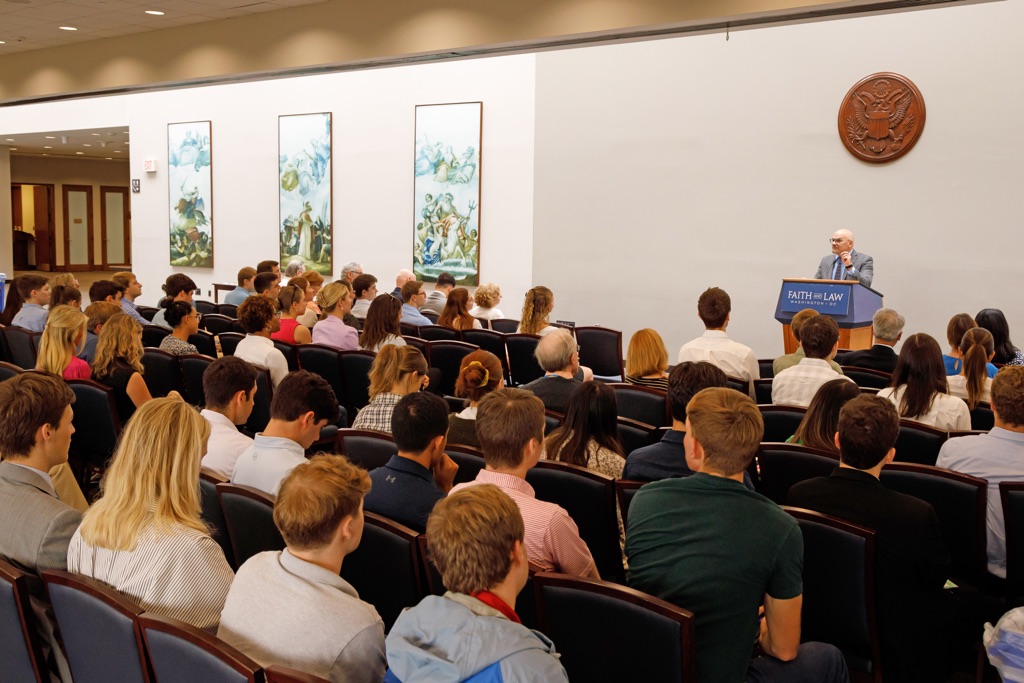
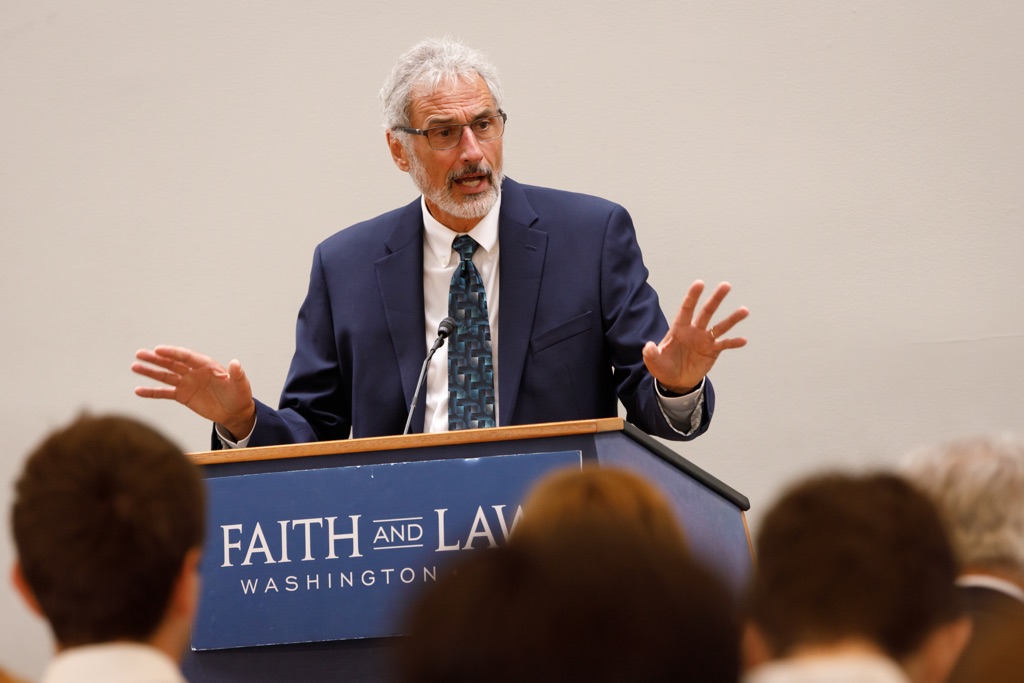
In a sweeping look at changes in 20th century jurisprudence concerning church and state, the Honorable Paul J. McNulty, ninth president of Grove City College gave a seminal talk entitled, Where Are We Now? Faith in the Public Square.
Unanimously confirmed as Deputy Attorney General in 2006, McNulty also served from 2001 to 2005 as the U.S. Attorney for the Eastern District of Virginia. He and John Palafoutas began Faith and Law when they were congressional aides in the early 1980s.
“1947 was a historic year for faith and the public square,” said McNulty. That year saw two historic occurrences that still have “continuing relevance.” The first was the Hugo Black opinion in Everson v. Board of Education. In contrast to traditional interpretations of the First Amendment, Black argued that Jefferson’s “wall” between church and state needed to be kept “high and impregnable.”
The second cultural marker was the publication of The Uneasy Conscience of Modern Fundamentalism by theologian Carl F. H. Henry. The seminal book described how Christian fundamentalists, in a reaction against modernism, had divorced themselves from the great social reform movements taking place.
“These two developments led to significantly reducing the influence of Christian faith in public life. By the 1970s, Christian engagement in public square was in pretty bad shape,” he said.
McNulty traced the next 40 years of Supreme Court decisions concerning religious liberty alongside Christian attempts to reunite the evangelistic and “social justice” aspects of the Gospel. From a legal standpoint, things have helpfully moved from strict separation back to accommodation. In terms of evangelical culture, movements ranging from the Moral Majority to Neo-Kuyperianism have sought different approaches to reclothing the “naked public square.”
McNulty expressed two concerns about where we are today. The first is that a second “great divorce” in evangelicalism is taking place. If the first divorce delinked Christian piety from social concern, the second divorce threatens to delink piety from politics. “I would caution us as a Christian community to not undervalue the importance of godly character for wise leadership. We should still insist on both.”
A second concern is the rise of illiberalism, which threatens toleration and the rule of law. “When Christians understand the importance of pluralism, there is more likely to be a receptivity to a public square where all can contribute in a constructive way.”
“Faith and Law is doing just what Faith and Law should be doing,” he concluded. “You are having thoughtful conversations about real issues and you’re trying to think those things through with wisdom and civility. Those fires need to be kept burning strong because, I believe, in the end, that is what will last. It underscores the value of Christian engagement in the public square.”
Thank you, Paul and Grove City College, for this tour de force of both faith and law. Faith and Law are privileged to carry on your legacy.


Faith and Law is a non-profit ministry started by policy makers and for policy makers.